

Last Updated: November 7, 2026
Quick Summary
A finishing oil is a raw oil added off the heat right before serving, and it makes hot soup taste better because heat destroys the fragile aroma and flavour compounds that give fresh oil its character. Drizzling a finishing oil over each bowl preserves those compounds, so the soup tastes brighter, feels richer and looks glossier.
- Add oil off the heat, right before serving, never while the pot is still bubbling.
- Use about one teaspoon per bowl, or two teaspoons for a large or starchy soup.
- Drizzle in a spiral from the centre outwards for even coverage and a deliberate look.
- Leave the oil on the surface for aroma, or stir it through for a creamier mouthfeel.
- Never store your finishing oil beside the stove, as warmth speeds flavour loss.
Table of Contents
- Why Finishing Oil Transforms a Bowl of Hot Soup
- When to Add Olive Oil to Soup for the Best Result
- How to Finish Soup with Olive Oil: A Simple Method
- Cooking Oil vs Finishing Oil: What's the Difference?
- Olive Oil Flavour Pairings for Soup
- Common Mistakes and Troubleshooting
- Choosing a Finishing Oil for Your Kitchen
- Explore Fresh Extra Virgin Olive Oil at Olio Nuovo
- Frequently Asked Questions
Why Finishing Oil Transforms a Bowl of Hot Soup
A finishing oil is a raw oil added at the very end of cooking, and it changes hot soup more than any other single step.
Here is the short answer to why use finishing oil for hot soups: raw oil carries aroma and flavour compounds that cooking destroys, and a finishing drizzle delivers them straight to the diner.
Below, we explain exactly when to add it, how much to use, and which oils suit which soups.
What Finishing Oil Actually Is
Finishing oil is a high-quality oil used raw, after cooking, to complete a dish. It is not an ingredient you fry with. It is a final seasoning, like flaky salt or cracked pepper.
The distinction matters because extra virgin olive oil is a fresh fruit juice. Its aroma, its peppery edge, and its polyphenols are all fragile.
A finishing oil is chosen for flavour, not for a high smoke point.
Aroma, Richness and Visual Appeal
Three things happen when you drizzle raw oil over hot soup.
- Aroma: volatile compounds rise with the steam and reach your nose first.
- Richness: fat coats the tongue and carries flavour across the palate.
- Shine: a thin layer of oil catches the light and makes the bowl look finished.
That last point is not vanity. A glossy surface signals care, and diners taste with their eyes before the spoon arrives.
When to Add Olive Oil to Soup for the Best Result
Add olive oil to soup off the heat, right before serving, never while the pot is still bubbling.
Heat exposure is the enemy. A raw oil stirred into a simmering pot for ten minutes loses the brightness you paid for.
So the sequence is simple:
- Take the pot off the heat.
- Ladle the soup into warm bowls.
- Drizzle the oil over each bowl.
- Serve immediately.
If you are reheating leftovers, finish each bowl individually rather than dosing the whole pot. That way nothing sits in the heat.
How to Finish Soup with Olive Oil: A Simple Method
Finishing a soup takes about ten seconds per bowl and needs no equipment beyond a small jug or a bottle with a pourer.
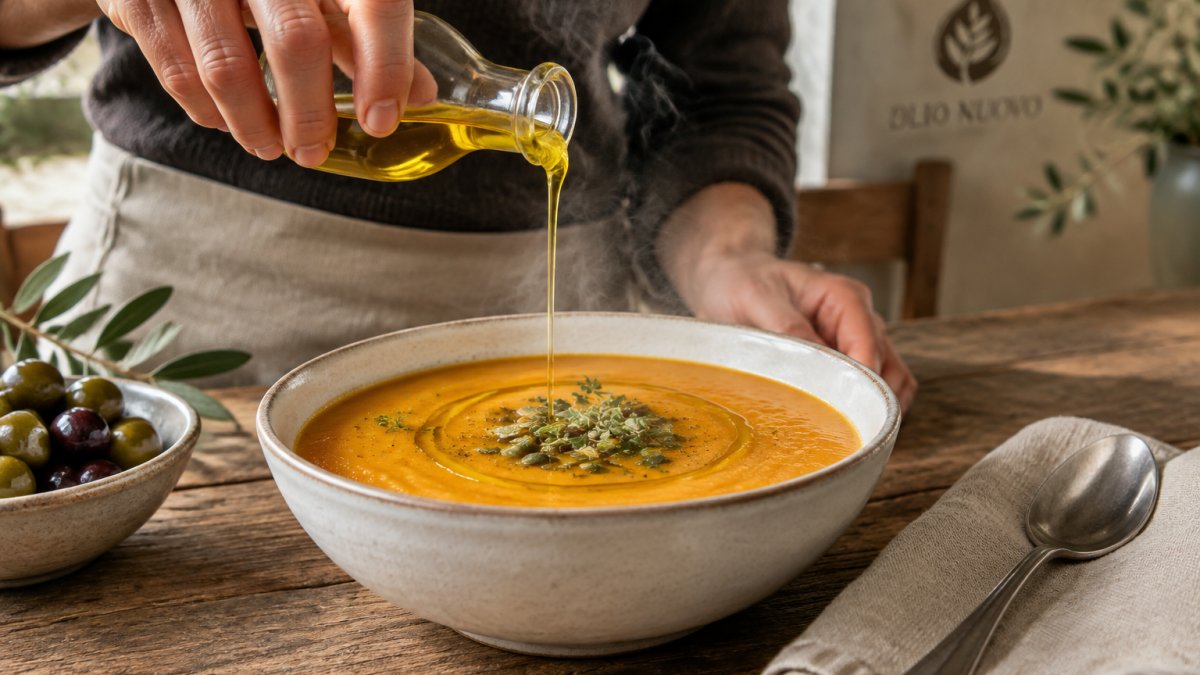
Warm the bowls first. A cold bowl pulls heat from the soup and dulls the aroma.
One insider tip: drizzle in a spiral from the centre outwards. It spreads more evenly than a single blob, and it looks deliberate.
How Much to Drizzle and How to Serve It
Use about one teaspoon per bowl for a standard serve, or two teaspoons for a large bowl or a thick, starchy soup such as pumpkin or potato. Start at the lower end. You can always add more at the table, but you cannot take it out.
A useful visual benchmark: one teaspoon spread across the surface of a standard bowl gives a thin, glossy sheen. If the oil pools in visible droplets or forms a continuous film, you have overshot.
Watch out: over-oiling is the most common mistake. Too much fat makes the soup greasy and coats the palate so the broth disappears. A thin sheen is the goal, not a slick.
Drizzle Pattern, Stirring and Temperature Timing
The pattern matters as much as the amount.
- Spiral from the centre outwards: gives even coverage and a deliberate look. Best for clear broths and purées alike.
- A single ring around the rim: leaves a clean centre for the first spoonful and looks striking on a purée.
- Three or four discrete drops: the lightest touch, suited to delicate consommés and seafood broths where a big oil would dominate.
Whether to stir is a genuine choice, not a rule. Leave the oil on the surface and each spoonful carries a different intensity, some bright and raw, some mellow.
On temperature: drizzle immediately after ladling, while the soup is still steaming. The steam carries the volatile aroma compounds upward, which is the whole point of a finishing oil.
For serving, a small glass jug at the table lets guests finish their own bowl.
Cooking Oil vs Finishing Oil: What's the Difference?
Cooking oil goes in at the start; finishing oil goes on at the end. That is the practical difference, and it drives every other decision.
| Factor | Cooking Oil | Finishing Oil |
|---|---|---|
| When used | Start of cooking | Right before serving |
| Heat exposure | High | None |
| Main job | Prevent sticking, build base | Add aroma, flavour, shine |
| Amount | Generous | One teaspoon per bowl |
| Best choice | Stable oil for the pan | Fresh, flavoursome extra virgin |
A common mistake is using your best oil to sauté onions. You lose the very characters that made it worth buying.
If you want to understand why premium oil behaves differently in the pan, our guide on why premium olive oil is better for cooking covers the detail.
Olive Oil Flavour Pairings for Soup
Match the oil to the soup the way you would match a wine to a meal. The goal is contrast or harmony, never competition.
- Pumpkin or squash soup: a grassy, peppery oil cuts the sweetness.
- Minestrone or bean soup: a strong, leafy oil stands up to tomato and legumes.
- Mushroom soup: a delicate, buttery oil rounds out the earthiness.
- Seafood or chicken broth: a light, bright oil keeps things clean.
- Tomato soup: a fruity oil with a peppery finish lifts the acidity.
Delicate soups need delicate oils. A big, bitter oil will flatten a light broth. If you enjoy matching oil to simple food, our guide on the best olive oil for dipping sourdough bread follows the same logic.
Beyond Olive Oil: Other Finishing Oils to Try
Olive oil is a versatile finishing oil, and other oils can also work.
- Toasted sesame oil: a few drops on an Asian-style broth.
- Pumpkin seed oil: deep and nutty, good on pumpkin soup.
- Walnut oil: delicate and rich, suited to mushroom or chestnut soups.
- Chilli oil: for those who want heat as the final note.
Keep the same rule: add them off the heat, in small amounts.
Dietary needs and allergen safety: oils are generally low in allergens, but infused and blended oils can carry other ingredients. Always check the label if you are cooking for someone with an allergy. Nut oils are not suitable for nut-free households.
Common Mistakes and Troubleshooting
Most finishing problems have simple fixes. Here are the ones we see most often, with the correction for each.
- Soup turns greasy or slick: too much oil, or oil added while the pot boiled. Fix: skim the surface with a spoon, or stir a splash of hot stock or water through to dilute the film. Next time, use less and drizzle off the heat.
- Oil tastes flat or dull: the bottle is old, has been stored warm, or has been open too long. Fix: buy fresher oil with a harvest date, and store it dark and cool. A flat oil cannot be rescued at the bowl.
- No aroma at all: the soup is too cool, or the oil is too refined and neutral. Fix: serve the soup properly hot in warm bowls, and choose a more robust, peppery extra virgin.
- Oil overpowers a delicate soup: the oil is too bitter or grassy for a light broth. Fix: use less, a few drops rather than a teaspoon, or switch to a milder, buttery style for seafood, chicken and vegetable broths.
- Oil separates and sits in pools: normal for a pure oil on a water-based broth, and not a fault. Fix: if you want it integrated, stir just before serving, or whisk a teaspoon of oil into a ladleful of soup and return it to the bowl to emulsify.
Watch out: never store your finishing oil beside the stove. That warm spot speeds up the decline of the very aromas you are trying to preserve, and no amount of technique at the bowl will bring them back. If flavour loss is a recurring issue, our guide on 7 ways to cook with artisanal olive oil without losing flavour covers technique in more depth.
Infused Oils: Safe Handling at Home
If you make your own garlic, chilli or herb oil, treat it as a fresh product, not a pantry staple. Garlic in oil, in particular, creates an environment where bacteria can grow if it is left at room temperature. The safe pattern most home cooks follow is to make small batches, store them in the fridge, use them within a week, and discard any batch that smells off or shows cloudiness beyond the normal haze of an unfiltered oil.
Choosing a Finishing Oil for Your Kitchen
Choose a fresh, extra virgin oil with a harvest date on the label, and buy in a size you will finish within a few months. Freshness beats price every time.
At Olio Nuovo, our Olio Nuovo fresh harvest extra virgin olive oil is pressed within 24 hours of harvest and available filtered or unfiltered, in 500ml or a 2 litre tin. The unfiltered style is bold and cloudy; the filtered style has a clearer appearance and a brighter, balanced flavour. You can browse the full Olio Nuovo range to compare the filtered and unfiltered styles side by side before you commit to a bottle.

Once you have chosen a bottle, learn how to store olive oil so it actually stays fresh. Keep it dark, cool and sealed, and it will reward you at the bowl.
Explore Fresh Extra Virgin Olive Oil at Olio Nuovo
Your next bowl of soup is one drizzle away from tasting like something you would order.
Olio Nuovo is pressed within 24 hours of harvest, and our Northern Hemisphere harvest is available in both filtered and unfiltered styles so you can choose the character you want.
Explore premium extra virgin olive oil at https://olionuovo.com.au and finish every bowl with oil worth tasting.
Frequently Asked Questions
Why do chefs drizzle olive oil over soup?
Chefs add finishing oil at the last moment because heat destroys the delicate aromas that make fresh extra virgin olive oil taste alive. Drizzled raw over a hot bowl, the oil releases its grassy, peppery notes into the steam, adds a richer mouthfeel and gives the surface a glossy shine. It is a quick way to lift a simple soup without changing the base recipe, and it lets the cook adjust seasoning bowl by bowl.
Can you put extra virgin olive oil in hot soup?
Yes, but timing matters. Stirring extra virgin olive oil into the pot while it cooks is fine for background richness, though much of the aroma cooks off. For the best flavour, ladle the soup into bowls first, let it sit for a moment, then drizzle finishing oil over the top right before serving. This preserves the raw oil's flavour profile and polyphenols rather than exposing them to sustained heat.
How much finishing oil should you drizzle over soup?
Start with about one teaspoon per bowl, or roughly half a tablespoon for a large serving. A thin ribbon across the surface is enough to carry aroma and add richness without making the soup greasy. Taste after the first drizzle and add a little more if needed. For a more assertive oil with a peppery finish, use less; for a mild, buttery oil, you can be slightly more generous.
Which soups pair well with a finishing oil?
Nearly any soup benefits, but the pairing should match the oil's character. A robust, peppery early-harvest oil suits tomato, minestrone and bean soups, while a milder, balanced oil works well with pumpkin, potato and creamy vegetable soups. Lentil and chickpea soups take a generous drizzle, and clear broths benefit from just a few drops to add shine and aroma without overwhelming the delicate flavours.

