

Table of Contents
- What Fake Olive Oil Brands Actually Sell You
- Your Extra Virgin Olive Oil Label Guide: What to Check Before You Buy
- Why Olive Oil Harvest Date Matters More Than the Brand Name
- How to Verify Olive Oil Certification and Traceability Claims
- The Olive Oil Freshness Test: What Works and What Doesn't
- How to Spot Fake Olive Oil Brands in the Shop: A Step-by-Step Check
- What to Do If You Suspect a Bottle Is Counterfeit
- Conclusion: Buy From Brands That Show Their Evidence
- Frequently Asked Questions
Last Updated: October 12, 2026
What Fake Olive Oil Brands Actually Sell You
Fake olive oil is a catch-all term, but it hides at least five different problems. Knowing which one you are looking at changes what you can do about it.
The five things 'fake' can actually mean
1. Adulteration. Cheaper oil, refined olive oil, sunflower, canola, or hazelnut, is blended into a bottle sold as extra virgin.
**2.
3. Substitution. A bottle sold as a single-estate or single-cultivar oil is actually a bulk blend from multiple sources.
4. Stale oil sold as fresh. This is the most common problem on supermarket shelves.
5. Legitimate blending. Not fraud at all. Many reputable producers blend oils from different groves, regions, or countries to hit a consistent flavour profile.
Why the distinction matters
If your oil is stale, the fix is to buy fresher, the producer did nothing wrong. If it is adulterated, that is a food safety and labelling issue you can report. If it is mislabelled, the problem is the claim, not the contents. Treating all five as 'fake' leads people to throw out honest oil and miss the bottles that actually deserve scrutiny.
A second mistake is assuming a peppery burn proves authenticity. Refined oil can be dosed with a peppery additive, and genuinely fresh oil from a mild cultivar may not burn at all.
What this guide does
Below, we walk through what each claim on a bottle actually means, which ones you can verify, and which tests at home are a waste of time. The goal is not to make you suspicious of every bottle, it is to give you a short list of claims that can be checked, and a clear idea of what to do when one of them fails.
Your Extra Virgin Olive Oil Label Guide: What to Check Before You Buy
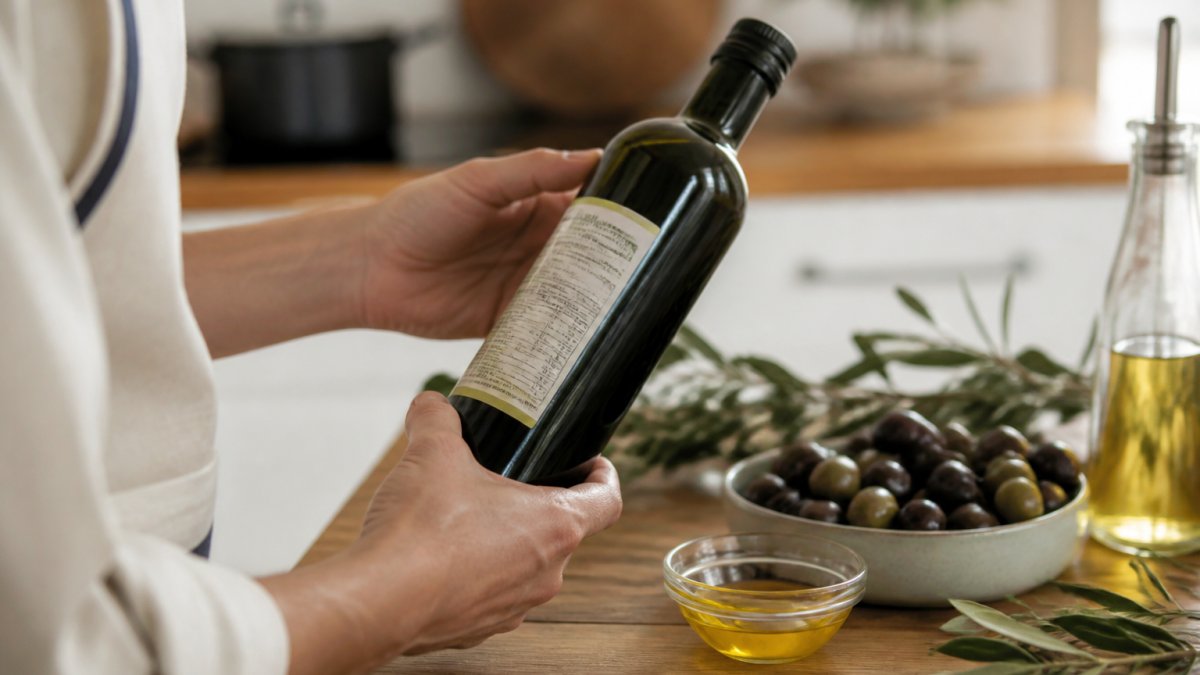
An extra virgin olive oil label guide starts with three things: grade, origin, and date. If any of those is vague, treat the bottle as unproven.
The Wording That Signals a Problem
Look for words that sound premium but mean nothing:
- "Pure olive oil" usually means refined oil blended with a little virgin oil
- "Light" or "extra light" describes flavour, not calories or quality
- "Cold pressed" with no harvest date is marketing
- "Product of Italy" can mean bottled there, not grown there
- Missing grade on the front label
Origin, Producer, and the 'Bottled In' Trap
"Bottled in Italy" tells you where the bottle was filled. It says nothing about where the olives grew.
Grown, produced, and bottled are three different claims. A bottle can be grown in Spain, blended in Italy, and bottled in Australia.
Look for a named producer, not just a brand. A farm or grove you can find is a farm that has something to lose.
Why Olive Oil Harvest Date Matters More Than the Brand Name
Harvest date beats brand name every time. Olive oil is a fresh juice, not a wine. It fades from the moment it is pressed.
A bottle with no harvest date is a bottle with something to hide. Freshness is the whole point of extra virgin oil, and it is the first thing a weak producer leaves off.
What to look for:
- A harvest date, not just a best-before date
- A date within the last 12 to 18 months
- A single harvest, not a blend across seasons
- Storage in dark glass or a tin, away from heat and light
Once opened, oil starts to fade. Keep it cool, dark, and capped, and use it within a few months for the best flavour.
How to Verify Olive Oil Certification and Traceability Claims
Olive oil certification and traceability is the paper trail behind the bottle. It links a specific batch to a specific grove, mill, and date.
A real certification has a number you can check. A quality seal with no number, no issuer, and no way to look it up is decoration.
Traceability means you can follow the oil from tree to bottle. That includes the olive variety or cultivar, the mill, and the bottling date. If a brand cannot tell you which grove your bottle came from, it cannot prove much at all.
The Olive Oil Freshness Test: What Works and What Doesn't
An olive oil freshness test at home can flag a bad bottle, but it cannot prove a good one. That is the part most guides skip.
Fridge Test, Taste Test, or Lab Test?
The fridge test is unreliable. Real extra virgin oil may cloud and thicken when cold, but so can other oils, and some genuine oils stay clear.
Taste tells you more. Fresh, well-made oil has a peppery finish and a slight bitterness at the back of the throat. That burn is a good sign, not a fault.
Only laboratory testing measures what matters: free acidity, peroxide value, and polyphenols. Those numbers decide whether a bottle is genuinely extra virgin.
| Check | What It Tells You | Can You Trust It? |
|---|---|---|
| Fridge test | Whether oil clouds when cold | No, too many false results |
| Taste and aroma | Roughly how fresh and lively it is | Partly, good for spotting stale oil |
| Harvest date | How old the oil actually is | Yes, if the date is real |
| Lab testing | Acidity, peroxides, polyphenols | Yes, this is the real measure |
| Certification lookup | Whether the claim is registered | Yes, when the number checks out |
How to Spot Fake Olive Oil Brands in the Shop: A Step-by-Step Check
Here is the process we would run on any bottle, in order. It takes about two minutes.
- Find the harvest date. No date, no sale. A best-before alone is not enough.
- Read the origin line. Look for a named country or region of harvest, not just a bottling location.
- Check the grade. It should say extra virgin, clearly, on the front.
- Look for a named producer. A grove or farm you can find online is a good sign.
- Check the certification. Note the issuer and any number, then look it up later.
- Note the lot number. You will need it if you ever have a problem.
- Inspect the bottle. Dark glass or a tin, sealed, with no sign of light damage or leakage.
What to Do If You Suspect a Bottle Is Counterfeit
Stop using the oil for anything where flavour matters, but keep the bottle, the receipt, and any packaging. The label, lot number, and proof of purchase are your evidence, and without them most complaints go nowhere.
Step 1: Document before you discard
Photograph the front label, the back label, the harvest or best-before date, the lot or batch code, and the receipt. Note the retailer, the date of purchase, and the price paid. If the oil tastes rancid, crayon-like, or flat, write that down too, sensory notes are useful supporting detail even though they are not proof.
Step 2: Go back to the seller first
Under the Australian Consumer Law, goods must be of acceptable quality and match their description. A bottle sold as extra virgin that is demonstrably not extra virgin, or that does not match the origin or harvest claim on the label, can be a failure to meet those guarantees. Ask the retailer in writing for a refund or replacement, and reference the specific claim you believe is false. Keep a copy of the message.
Step 3: Contact the producer named on the label
Ask them to confirm the batch. Give them the lot code and the harvest date. A transparent producer will usually answer within a few days and can tell you whether the bottle is theirs, whether the batch is genuine, and where it was bottled. A vague or evasive reply is itself useful information.
Step 4: Report to the right regulator
In Australia, misleading labelling and false origin claims on food fall under the Australian Consumer Law, administered by the ACCC at the federal level and by state and territory fair trading or consumer affairs agencies locally.
You do not need to prove the oil is fake to lodge a report. A clear description of the claim, the evidence you have, and the retailer's response is enough for the regulator to decide whether to investigate.
Step 5: Leave a factual review
A short, specific review, naming the product, the lot code, and the claim that failed, helps other buyers and puts pressure on weak producers. Keep it factual. 'The label says harvested 2024 but the oil tasted flat and the producer could not confirm the batch' is more useful than 'this is fake'.
What to expect
You will not always get a refund, and regulators do not investigate every report. But a documented paper trail is what pushes misleading products out of the market, and it is the only lever an individual buyer has. If several buyers report the same product, the pattern becomes visible.
Conclusion: Buy From Brands That Show Their Evidence
The brands worth your money show their evidence: a harvest date, a named grove, a lot number, and a certification you can look up. Everything else is packaging.
At Olio Nuovo, we press within 24 hours of harvest and deliver twice a year from our local and Northern Hemisphere harvests.
If you want a bottle that answers every question on this list, order online now and taste what real freshness means.
Frequently Asked Questions
How can you tell if an olive oil brand is fake?
No single clue proves a bottle is fake, but a combination of red flags is telling. Check for a specific harvest date (not just a best-before), a named producer or estate, a protected origin or certification mark, and a lot number. If the label says 'blend of olive oils' or only 'bottled in' a country without naming where the olives grew, treat the authenticity claim with caution. Taste can help: fresh extra virgin olive oil should have some bitterness and a peppery throat catch, not a flat, greasy finish.
What should you look for on an extra virgin olive oil label?
Start with the harvest date, which tells you when the fruit was pressed, not when the bottle was filled. Look for a named producer or grove, a specific region of origin, and any certification mark such as a protected designation or an organic logo. A lot or batch number means the oil can be traced. Wording like 'cold-pressed' or 'first cold press' is useful context, but it does not by itself confirm the oil is genuine extra virgin. If the label is vague about origin and date, keep looking.
Does a bitter or peppery taste mean olive oil is authentic?
Bitterness and a peppery finish are typical of fresh extra virgin olive oil, because they come from polyphenols and other compounds in the fruit. A bland, buttery oil with no bite is more likely to be refined or old. That said, taste alone cannot confirm authenticity, since some adulterated oils are blended to mimic the peppery note. Use taste as one signal alongside the label, harvest date, and traceability details rather than as proof on its own.
Can you tell if olive oil is fake by putting it in the fridge?
The fridge test is unreliable. Real extra virgin olive oil can cloud or solidify at cold temperatures because of its natural waxes and saturated fats, but so can many other oils, and some genuine oils stay clear depending on their variety and processing. A fake blend may also cloud if it contains enough olive oil. Treat the fridge test as a curiosity, not a verification method. For a definitive answer, rely on documented harvest dates, traceability, and laboratory testing where available.
