

Table of Contents
- What Separates Premium Artisanal Olive Oil From Supermarket Bottles
- How to Taste Olive Oil Like a Professional
- How to Tell If Premium Artisanal Olive Oil Is Genuine
- Extra Virgin Olive Oil Health Benefits Worth Knowing
- Pairing Artisanal Olive Oil With Food by Flavour Profile
- Olive Oil Storage Tips to Protect Flavour and Shelf Life
- Frequently Asked Questions
Last Updated: September 10, 2026
What Separates Premium Artisanal Olive Oil From Supermarket Bottles
Premium artisanal olive oil is an extra virgin olive oil pressed from a single harvest, bottled shortly after picking, and delivered while its chemistry is still at its peak. The difference from a supermarket bottle comes down to time, not branding.
Supermarket oil is typically blended from multiple harvests and hemispheres for year-round supply, so the bottle may be two years old before you open it. Artisanal producers work the other way: a single grove, a single season, and a pressing window measured in hours.
At Olio Nuovo, we press within 24 hours of harvest and bottle immediately, because the compounds behind olive oil's peppery kick and green aroma fade the moment the fruit leaves the tree. Below are the markers that tell you whether a bottle is genuinely fresh or just marketed that way.

Harvest date, acidity level and the freshness gap
The harvest date is the single most useful number on a label. It tells you when the fruit was picked, not when the bottle was filled, and those two dates can be years apart.
Acidity level matters too, but less than most people assume. Free acidity measures how much the oil's triglycerides have broken down, so a lower figure generally signals healthier fruit and faster processing. Extra virgin oil must sit at or below 0.8% free acidity under the International Olive Council trade standard, but a bottle at 0.2% is not automatically better than one at 0.4% if the flavour has already faded.
What actually separates the two categories is the freshness gap:
| Marker | Supermarket bottle | Artisanal bottle |
|---|---|---|
| Harvest date on label | Rarely shown | Stated by season |
| Time from picking to pressing | Often days to weeks | Within 24 hours |
| Blending | Multi-origin, multi-year | Single harvest |
| Filtration | Usually filtered | Often unfiltered |
| Peak drinking window | Unknown | First 12-18 months |
How to Taste Olive Oil Like a Professional
Tasting olive oil professionally is a structured sensory exercise, not a wine-style performance. You need a small glass, a warm hand, and about ninety seconds.
Pour roughly 15ml into a glass, cup it in your palm to warm the oil, then cover and swirl; warmth releases the volatile aromatics cold oil holds onto. Inhale twice through the nose, then sip and draw air across the oil between your teeth. That slurp spreads the oil across your palate and pushes aroma into your nasal cavity, where most of the flavour registers.
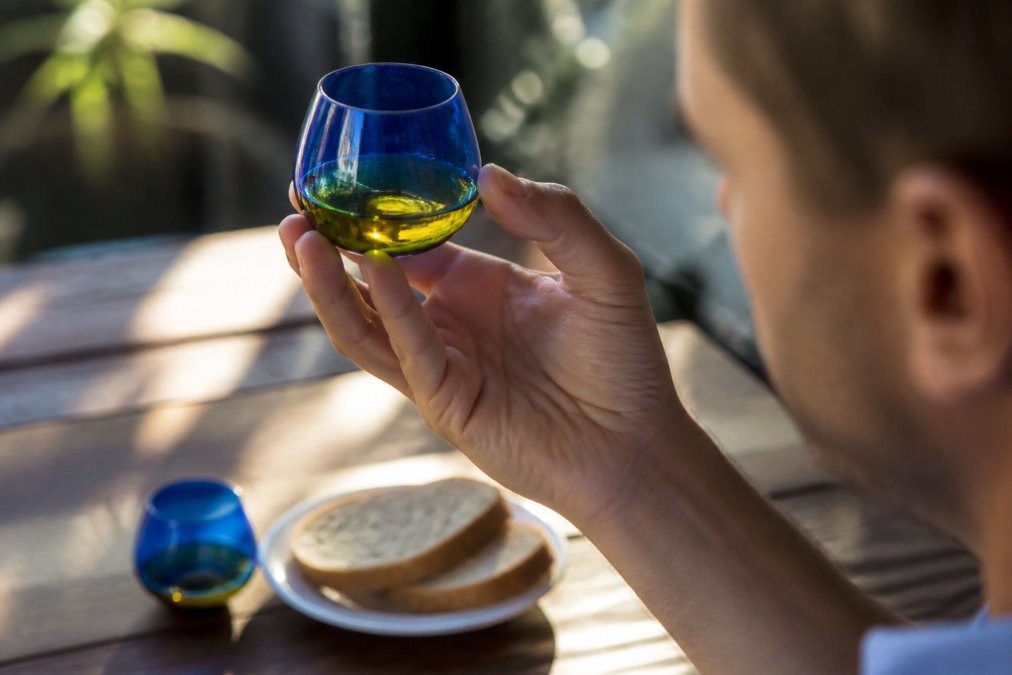
Reading bitterness, fruitiness and pungency
The three positive attributes in professional sensory analysis are fruitiness, bitterness and pungency. Fruitiness is the aroma of fresh fruit, from green and grassy to ripe and floral. Bitterness shows up on the back of the tongue. Pungency is the peppery catch at the back of your throat that makes you cough.
That cough is not a flaw; it signals fresh polyphenols and is one of the clearest indicators that a bottle is young. A bland oil with no bitterness and no pepper is usually old, whatever the label claims about its grade.
How to Tell If Premium Artisanal Olive Oil Is Genuine
Genuine artisanal oil leaves a paper trail; fake or repackaged oil usually does not. Most buying guides stop at "look for a harvest date," but counterfeit and adulterated oil is a major pain point for premium buyers, and the sensory cues below are more reliable than most people realise.
The label checks that actually matter
First, look for a harvest date rather than a best-before date. Best-before dates are typically set 18 to 24 months from bottling, telling you nothing about when the fruit was picked; a harvest date narrows the window to a single season. Australian olive oil standards
Second, check for a named producer, estate or grove. Oil sold under a vague regional name is far harder to trace; a named estate is not a guarantee, but it is a starting point you can verify.
Third, look for independent verification. Lab-tested oil with published polyphenol and free acidity figures, plus competition results from named bodies, gives you something concrete to check. Olio Nuovo publishes this information because transparency only means something when a buyer can verify it.
Counterfeit detection at home: the sensory tests
Beyond the label, your senses are the most practical tool you have. Here is how to run a basic authenticity check without a laboratory.
The fridge test. Chill the bottle for a few hours. Real extra virgin oil solidifies and turns cloudy as its waxes and saturated fats crystallise, while heavily refined or adulterated oil stays liquid and clear. This is not definitive on its own, as some genuine oils from warmer climates contain fewer waxes, but a bottle that refuses to cloud at all is worth questioning.
The smell test. Pour a small amount into a glass, warm it in your palm, and smell. Fresh extra virgin oil smells green, grassy or fruity; rancid oil smells like crayons, putty or old nuts. A flat or odourless aroma means the oil is likely old or heavily refined.
The taste test. Take a small sip and draw air across it. A genuine early-harvest oil delivers bitterness on the back of the tongue and a peppery catch at the back of the throat. Greasy, bland or cardboard-like oil is past its best or not what the label claims.
The swallow test. A fresh, high-polyphenol oil often produces a peppery sensation that makes you want to cough, a signal of freshness, not a flaw. An oil that slides down with no sensation is usually old or refined.
What the paper trail should include
A genuine artisanal bottle gives you three things: a harvest date, a named producer or estate, and independent verification. If any are missing, you are relying on marketing rather than evidence. Treat the label as claims to check, not facts to trust, and when a producer publishes lab figures and harvest dates, you have found a bottle worth tasting.
Extra Virgin Olive Oil Health Benefits Worth Knowing
Extra virgin olive oil is the least processed grade, which is why it retains the most polyphenols and vitamin E, compounds largely stripped out during refining, so standard "pure" or "light" oil delivers far less. What most guides miss is how those compounds behave in the bottle and in the body, and why freshness changes the health equation entirely.
The compounds that matter and how they behave
The headline polyphenol in extra virgin oil is hydroxytyrosol, along with related compounds such as oleocanthal and oleuropein. Oleocanthal causes the peppery catch at the back of your throat, which is why professional tasters treat pungency as a positive attribute. Oleocanthal and its health effects
These compounds are not stable; they decline as oil ages and is exposed to heat, light and oxygen.
The fat profile is the other headline. Olive oil is predominantly monounsaturated fat, associated with favourable cholesterol balance when it replaces saturated fat. Extra virgin oil also carries vitamins A, D, E and K, plus antioxidant polyphenols such as hydroxytyrosol.
Why freshness is a health issue, not just a flavour issue
The health benefits of extra virgin olive oil are tied to freshness because polyphenol content declines over time. An old extra virgin oil still beats butter, but it is not delivering the antioxidant load you paid for. If health is your main reason for buying premium oil, buy the freshest bottle you can find and use it within the year.
A high-polyphenol early-harvest oil used within six months of opening delivers more of these compounds than a cheaper bottle stretched over two years, the honest case for buying smaller quantities more often.
How to use it to get the most from the compounds
Heat is the enemy of polyphenols. High-heat frying degrades some of the delicate compounds, though extra virgin oil remains a stable cooking fat compared with many seed oils. The better approach is to cook with a strong oil and reserve your freshest, most pungent oil for finishing, where the polyphenols reach your plate intact.
A simple pattern many practitioners follow is to keep two bottles: one for the pan and one for the plate. The finishing oil is where you want the peppery catch, because that sensation signals the polyphenols are still present.
Pairing Artisanal Olive Oil With Food by Flavour Profile
Matching oil to food by flavour profile is the fastest way to get more out of a premium bottle.
Think in three bands. Delicate, buttery oils with low bitterness suit fish, mozzarella, eggs, mayonnaise-based dishes and anything where you do not want the oil to dominate. Medium, green and grassy oils work across roasted vegetables, pasta, grains and white meat. Strong, intensely peppery oils with high bitterness are built for red meat, legumes, tomato-heavy sauces, grilled bread and finishing soup.
The rule is simple: the stronger the food, the more pungent the oil it can carry. A high-polyphenol early-harvest oil over delicate white fish buries the fish; a mild oil on chargrilled steak vanishes without a trace.
Olive Oil Storage Tips to Protect Flavour and Shelf Life
Storage decides how long your oil stays worth drinking. The enemies are heat, light, oxygen and time, in that order.
Keep the bottle in a dark cupboard away from the stove; heat accelerates oxidation faster than anything else in a normal kitchen. Choose dark glass or a tin, since clear glass lets UV light break down the chlorophyll and aromatic compounds that give the oil its character.
Decanting is where most people go wrong. Pouring oil into a wide, decorative bottle increases the surface area exposed to oxygen and speeds the decline. If you decant, use a small vessel you will finish quickly.
Once opened, an artisanal oil is best used within three to six months for full flavour, and stays good for around 12 months if stored properly. Unopened, a well-sealed bottle holds its peak for roughly 18 months from harvest. That answers whether a twice-yearly delivery suits you: two bottles a year is one every six months, neatly inside the window where the oil is still at its best.
The real challenge with premium artisanal olive oil is not finding a bottle. It is finding one where the harvest date, the pressing window and the lab figures all hold up to scrutiny, and where you can actually verify them before you commit.
Olio Nuovo presses within 24 hours of harvest, bottles unfiltered, and delivers twice yearly from local and Northern Hemisphere harvests so your oil arrives close to its peak rather than months past it. Our oils are award-winning, and produced by a team with more than 26 years in the grove. If you want oil that tastes like the season it came from, order online now and taste the difference a genuine harvest date makes.
Frequently Asked Questions
What defines a premium artisanal olive oil?
Four things separate premium artisanal olive oil from mass-produced bottles: how fast it is pressed after harvest, whether it is filtered, how it is stored, and how much you can verify. Oil pressed within 24 hours of picking keeps its polyphenols and peppery finish intact. Unfiltered oil carries more texture and fruitiness. Dark glass or tins with UV protection slow oxidation. Lab-tested acidity levels and a visible harvest date let you check the claims rather than trust the label.
How can you tell if an olive oil is high quality?
Start with the harvest date, not the best-before date. Fresh oil is usually sold within 12 to 18 months of pressing. Check the acidity level on the label; quality extra virgin sits below 0.8%. Pour a spoonful and look for a peppery catch at the back of your throat, which signals polyphenols. If the oil tastes flat, greasy or like crayons, it has oxidised. A single-estate bottle with lab-tested figures tells you more than any award sticker.
How should premium olive oil be stored to maintain freshness?
Keep it in a dark glass bottle or tin, away from light and heat. Store it in a cupboard rather than beside the stove, and never above the fridge. Seal the cap tightly after each pour, because oxygen drives oxidation. A 500ml bottle used within six to eight weeks of opening holds its character best. If you buy in larger volumes, decant a small amount for daily use and keep the rest closed and cool.
What are the benefits of choosing unfiltered, freshly pressed olive oil?
Unfiltered oil keeps tiny olive particles suspended in the liquid, which carry flavour compounds and antioxidants. That is why it tastes more vivid and often looks cloudy. Freshly pressed oil also retains higher levels of monounsaturated fats and vitamins A, D, E and K. The trade-off is a shorter shelf life, so unfiltered bottles reward fast use. Pair fresh, peppery oil with salads and finishing dishes where its character shows.
